

Production
1979–1994
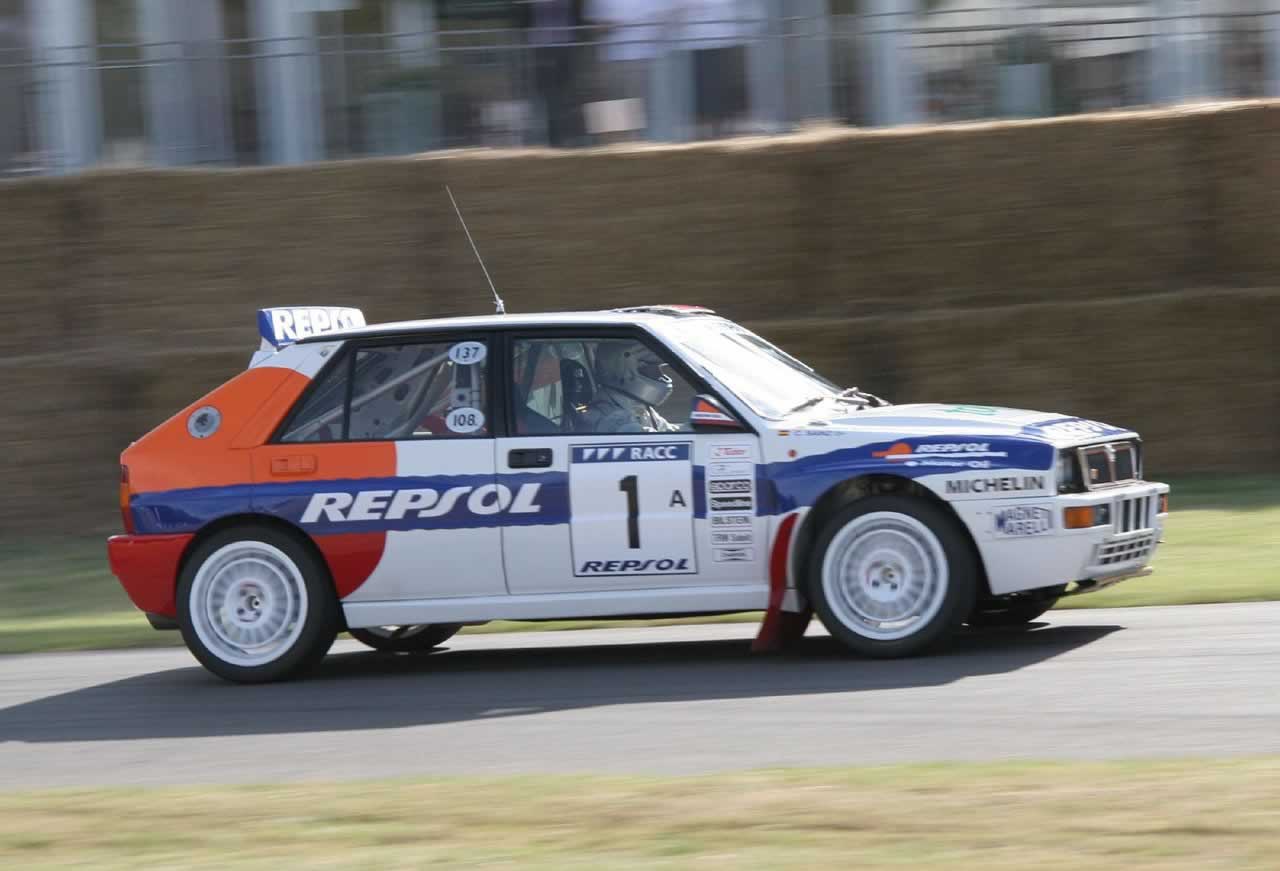
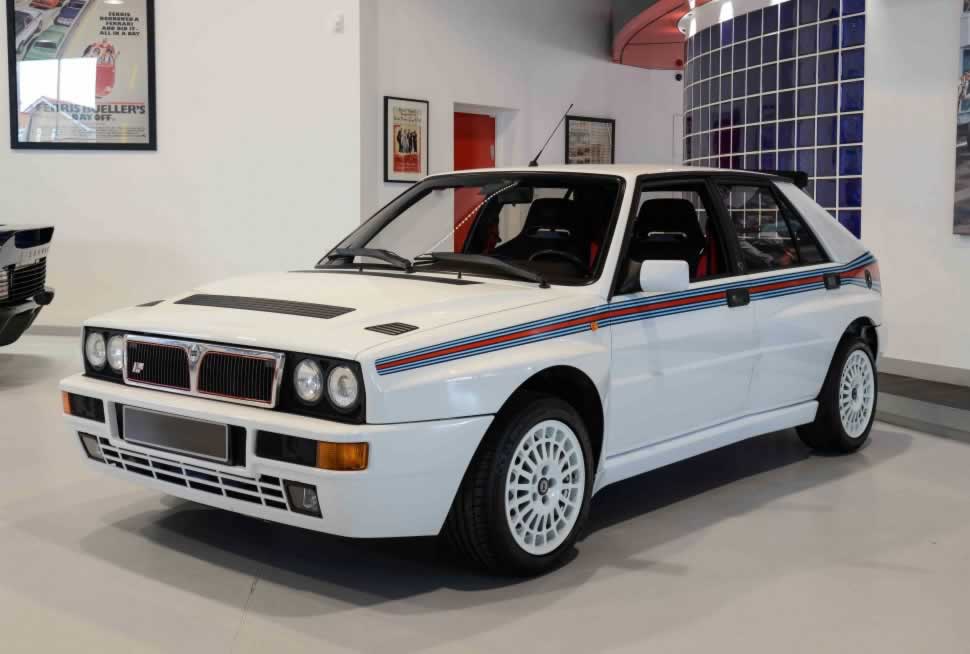
The first generation Delta dominated the World Rally Championship during the late 1980s and early 1990s. The homologation requirements of Group A regulations meant marketing road-going versions of these competition cars — the Lancia Delta HF 4WD and HF Integrale. A total of 44,296 Integrales were produced.
Body styles
5-door hatchback





Lancia Integrale History
The first Delta (Tipo 831) was a five-door hatchback, designed by Giorgetto Giugiaro and released in 1979. Between 1980 and 1982, it was also sold in Sweden, Denmark and Norway by Saab Automobile, badged as the “Saab-Lancia 600” to replace the retired 96 model. The Delta was voted the 1980 European Car of the Year.
A special Delta HF Integrale version was a four-wheel drive hot hatch with a turbocharged petrol engine. Modified versions of the HF dominated the World Rally Championship, scoring 46 victories overall and winning the Constructors’ Championship a record six times in a row from 1987 to 1992, in addition to Drivers’ Championship titles for Juha Kankkunen (1987 and 1991) and Miki Biasion (1988 and 1989).
The Lancia Delta S4, which the works team ran immediately prior to the HF 4WD and Integrale models’ world championship careers from the season-ending 1985 RAC Rally until the end of the 1986 season, while sharing the same name and appearance, was a Group B race car designed and built specifically for rallying, and was entirely different from the mass-produced consumer versions.
Development
The car that would become the Delta during its development went by the project codename “Y 5”, was conceived as an upmarket front-wheel drive small family car positioned below the larger Beta; an offering around four metres in length had been absent from Lancia’s lineup since the demise of the Fulvia Berlina in 1973. This platform, derived from the platform of the Fiat Ritmo, with different suspension and more welding points, for a stiffer chassis.
Design was by Giorgetto Giugiaro’s Italdesign. Its platform put together MacPherson suspension developed for the Beta with four-cylinder, SOHC engines derived from the Fiat Ritmo. The Fiat engines were revised by Lancia engineers with Weber twin-choke carburettors, new inlet manifolds, exhaust systems and electronic ignitions, changes that combined to produce 85 PS (63 kW; 84 hp), ten more horsepower than the same engines did in the Ritmos.[5] To achieve its market positioning the Delta offered features uncommon in the segment, as fully independent suspension, rack and pinion steering, available air conditioning, an optional split-folding rear seat, a height-adjustable steering wheel, and a defogger.[6] Its three-piece body-coloured bumpers made from polyester resin sheet moulding compound were claimed by Lancia to be a first in the industry. The heating and ventilation were developed with help from Saab, experts in the field, who also claimed to have had a hand in the rust proofing of the Delta. It was also thanks to Saab that the split-folding rear seats were developed and the bootlid was extended all the way down to the bumper, simplifying loading and unloading. In September 1987 the HF 4WD was replaced by the more capable Delta HF integrale, which in turn evolved into the 16-valve Delta HF integrale 16v in March 1989.
A new sporty trim level for the 1.3 was added in May 1990, the Delta Personalizzata, available in red or white with contrasting twin pinstripe and electric blue cloth upholstery; standard equipment comprised body-colour wing mirrors, tachometer, clock and sport steering wheel. Later that year the sport models (turbo ds, GT i.e., HF turbo and HF integrale 16v) received richer equipment and interiors in new combinations of colourful striped velour and Alcantara. The optional Recaro seats of the two HF models were now fully upholstered in perforated Alcantara, green or grey depending on the exterior colour. On the integrale only, they could be had in perforated black leather for an additional fee.
1991 Revisions
In June 1991 the last update of the first generation Lancia Delta went on sale, almost twelve years after its 1979 début. The front-wheel drive range was reduced to three models, namely LX, GT i.e. and HF turbo. On all three of them, small touches like body-colour side skirts and dual body-colour wing mirrors created a more up to date look. The LX and GT i.e. wore white front turn indicators, a grille with chrome vertical bars, the louvered bonnet from the original HF integrale, and optional 8-spoke diamond-cut alloy wheels from the Dedra. The Delta LX had abandoned the 1.3 in favour of a revised version of the 1.5-litre engine. Updated colour and trim included green and blue “Metallescente” mica paint and Glen plaid cloth upholstery on lower models, while sports models continued with the interiors introduced in 1990. The HF integrale 16v—due to be replaced at the end of 1991 by the much improved HF integrale “Evoluzione”—handed down its dual round headlights and domed, vented bonnet to the HF turbo, which now looked almost like an integrale. A few months later the HF turbo even replaced its traditional red model identification script on the radiator grille with a yellow HF badge, like the one found on the newly introduced Evoluzione. Concurrently the GT i.e. received new “1600 i.e.” badging.
A very final, minor round of updates was made when the 1992 models switched to a catalytic converter-only engine offering, in compliance with Euro 1 emission standards. The Delta GT i.e. morphed into the 1600 i.e., and together with the HF turbo was the sole front-wheel drive Delta offered. All variants acquired new, more understated upholstery: the HF turbo switched from velour to herringbone inserts on the Alcantara seats and door panels, while the 1600 abandoned Alcantara altogether for full Glen plaid cloth. As the second generation was ready to be launched in 1993, after a career of 13 years the front-wheel drive Delta was phased out at the end of 1992, after over 478,000 had been produced. Production of the HF integrale would continue for two years more.
Delta HF Integrale “8V”
The Lancia Delta HF integrale incorporated some of the features of the Delta HF 4WD into a road car. The engine was an eight-valve 2.0 L fuel injected four-cylinder, with balancing shafts. The HF version featured new valves, valve seats and water pump, larger water and oil radiators, more powerful cooling fan and bigger air cleaner. A larger capacity Garrett T3 turbocharger with improved airflow and bigger intercooler, revised settings for the electronic injection-ignition control unit and a knock sensor, boost power output to 185 PS (136 kW; 182 hp) at 5,300 rpm and maximum torque of 31 m·kgf (304 N·m, 224 lbf·ft) at 3,500 rpm.
The HF integrale had permanent four-wheel drive, a front transversely mounted engine and five-speed gearbox. An epicyclic centre differential normally splits the torque 56 per cent to the front axle, 44 per cent to the rear. A Ferguson viscous coupling balanced the torque split between front and rear axles depending on road conditions and tyre grip. The Torsen rear differential further divides the torque delivered to each rear wheel according to grip available. A shorter final drive ratio (3.111 instead of 2.944 on the HF 4WD) matched the larger 6.5×15 wheels to give 24 mph/1,000 rpm (39 km/h per 1,000 rpm) in fifth gear.
Braking and suspension were uprated to 284 mm (11.2 in) ventilated front discs, a larger brake master cylinder and servo, as well as revised front springs, dampers, and front struts.
The HF integrale was facelifted with bulged wheel arches for the wider section 195/55 VR tyres on 15-inch 6J alloy wheels. A new bonnet incorporated air louvres while the restyled bumpers wrapped around to meet the wheel arches at front and rear. The front bumper, now wider, incorporates air intakes and for the rectangular auxiliary driving lights. The side skirts are faired into the wheel arches at front and rear and the twin rear view mirrors are finished in body colour. There were only 50 RHD factory built cars, none of which were officially imported to the UK.
Delta HF Integrale 16v
The 16v integrale was developed for rallying, introduced at the 1989 Geneva Motor Show, and made a winning debut on the 1989 San Remo Rally.
It featured a raised centre of the bonnet to accommodate the new 16-valve engine, as well as wider wheels and tyres and new identity badges front and rear. The torque split was changed to 47% front and 53% rear.
The turbocharged two-litre Lancia 16v engine produced 200 PS (147 kW; 197 hp) at 5,500 rpm, for a maximum speed of 137 mph (220 km/h) and 0–100 km/h (0-62 mph) in 5.7 seconds. Changes included larger injectors, a more responsive Garrett T3 turbocharger, a more efficient intercooler, and the ability to run on unleaded fuel without modification.
Alongside the 16v Lancia introduced an eight-valve variant equipped with a three-way catalytic converter—which reduced output to 177 PS (130 kW; 175 hp) — intended for those European markets where such emission control equipment was mandatory.
In the summer of 1990 some small updates were made to all Delta sports models, with the integrale receiving new upholstery materials. Like on the HF turbo, the combination of light grey Alcantara and multicolour stripe cloth used since 1986 was replaced by dark grey Alcantara with diagonal stripe velour. If the Recaro optional seats were ordered, the buyer could choose either full dark grey or green embossed Alcantara upholstery, or extra-cost perforated black leather.
Delta HF integrale “Evoluzione”
At the September 1991 Frankfurt Motor Show Lancia introduced an heavily revised Delta HF, once again named “Delta HF integrale”—but which became better known as the “HF integrale Evoluzione” or simply “HF integrale Evo”. Evoluzione cars were built from October 1991 through 1992. At the end of the victorious 1991 World Rally Championship season, where the HF integrale 16v had won both the drivers’ and manufacturers’ championships, Lancia officially retired from rallying. Despite this, racing development of the HF integrale continued, and factory-developed HF integrale Evos were fielded by independent Martini Racing-sponsored Jolly Club for the 1992 season. Thanks to the two factory-backed privateer teams, Lancia won its sixth and final consecutive Constructor’s World Rally Championship. These were to be the final homologation cars; the catalytic 1993 Evoluzione 2 was not developed by the factory into a rally car.
The Evoluzione’s engine was the same turbocharged 16-valve two-litre used on the previous model, but power had increased to 210 PS (154 kW; 207 hp) at 5,750 rpm, chiefly thanks to a new, single outlet 60 mm diameter exhaust system. Maximum torque was unchanged at 31 kgf⋅m (300 N⋅m; 220 lbf⋅ft), but was now reached at a higher, 3,500 rpm. An eight-valve “kat” catalytic converter-equipped variant, with an unchanged 177 PS output, continued to be produced for countries where such equipment was mandatory. Mechanical changes included a strengthened steering rack and a power steering oil cooler. The suspension was reworked and strengthened, e.g. using box section track control arms. Front strut towers were raised, which necessitated an aluminium strut brace. The braking system featured larger diameter discs and vacuum servo, and fixed two-piston Brembo calipers at the front. No changes were made to the four-wheel-drive system.
Front and rear tracks were wider than on earlier Deltas, by 54 and 60 mm (2.1 and 2.4 in) respectively. The wheel arch bulges were consequently extended and made more rounded. They were now made in a single pressing, rather than welded on as they previously were. Besides the aforementioned wings, the Evoluzione bodywork included a new bonnet, front and rear bumpers, box section side skirts, rear doors, and a rear spoiler. The front end was distinguished by twin, smaller diameter round headlamps—with the outboard pair, the dipped beams, being of the novel projector type. The bonnet had a wider and taller hump, and new lateral air slats to further assist underbonnet ventilation. The roof spoiler above the tailgate was manually adjustable in three positions—lowered, raised or fully raised via two included brackets—favouring either Cd or rear axle downforce. New five-bolt 7½Jx15-inch Speedline Montecarlo alloy wheels, with the same design of those used on the rally cars, wore 205/50 tyres. Other outside changes were new windscreen wipers with integrated spoilers, a sports-type gas cap, and new yellow HF badges, decorated with the traditional red elephant used on Lancia HF cars of the past.
Paint options included three solid colours (white, rosso Monza (red) and lord blue), and extra-cost “metallescente” mica colours (black, madras blue, winner red and derby green). Inside the cabin there was a new leather-covered Momo Corse sports steering wheel. Interior trim was otherwise unchanged from the 1990 model HF Integrale 16v. The standard seat interior was done in a combination of dark grey |Alcantara and grey velour with diagonal coloured stripes. If the Recaro anatomic seats (which came as standard on some markets) were ordered, upholstery was in perforated Alcantara (either green with white, grey and black exterior colours, or dark grey with all others) or, at extra cost, in black perforated leather. Notable options were a six-way Bosch anti-lock braking system, an electric metal sunroof, and air conditioning. Some of these features were standard on some markets.
Starting in late 1992 assembly of the Evoluzione was contracted to Maggiora, a body panel supplier for Fiat which became a car manufacturer. Maggiora took over part of the recently shuttered Lancia Chivasso plant and restarted production on 16 October 1992.
Delta HF Integrale “Evoluzione II”
Presented in June 1993, the second Evolution version of the Delta HF Integrale featured an updated version of the two-litre 16-valve turbo engine with more power, as well as a three-way catalyst and Lambda probe. A Marelli integrated engine control system with an 8 MHz clock frequency was installed, incorporating:
- Timed sequential multipoint injection
- Self-adapting injection times
- Automatic idling control
- Engine protection strategies depending on the temperature of intaken air
- Mapped ignition with two double outlet coils
- Three-way catalyst and pre-catalyst with lambda probe (oxygen sensor) on the turbine outlet link
- Anti-evaporation system with air line for canister flushing optimised for the turbo engine
- New Garrett turbocharger: water-cooled with boost-drive management i.e. boost controlled by feedback from the central control unit on the basis of revs/throttle angle
- Knock control by engine block sensor and new signal handling software for spark park advance, fuel quantity injected, and turbocharging
- The engine developed 215 PS (158 kW; 212 hp) DIN (against 210 PS on the earlier non-catalytic version) and maximum torque of 32 kgf·m (314 N·m) (formerly 31 kgf·m or 300 N·m).
The 1993 Integrale received a cosmetic and functional facelift that included:
- New 16″ light alloy rims with 205/45 ZR 16 tyres;
- Body colour roof moulding to underline the connection between the roof and the Solar control windows;
- Aluminium fuel cap and air-intake grilles on the front mudguards;
- Red-painted cylinder head;
- New leather-covered three-spoke MOMO steering wheel.
- Standard high-back Recaro sport seats.
With ABS, fog lamps and Recaro seats now standard on all markets, the sole optional extra was air conditioning. The choice of paint finishes was reduced to just three solid colours: bianco (white), rosso Monza (red) and blu Lancia (dark blue). Interior upholstery was always done in beige Alcantara with diagonal stitching on seat centres and door panels. Additional colour and trim combinations were made available through a number of limited editions.